Fraud Intelligence
Make relationships visible. Make investigations explainable.
From the repository · README
A snapshot of the project’s own documentation. Read the latest on GitHub ↗
Insurance Fraud Intelligence & Investigation Platform (POC)



🌐 Live Deployment: https://insurance-fraud-intelligence-poc-1.onrender.com
🔑 Demo Analyst Access: Click the "Use Demo Analyst Account" button on the sign-in screen (or useanalyst@demo-insurance.com/demo123).
A focused engineering proof of concept demonstrating that insurance fraud detection should not be treated only as an individual claim classification problem. A useful fraud-intelligence system should correlate claim-level signals, historical behavior, and relationships across entities, produce an explainable risk priority, and help investigators examine the evidence before making a final decision.
Synthetic Demo Data Notice: All claimant names, claim IDs, policy numbers, healthcare facilities, repair workshops, bank account identifiers, vehicle records, medical descriptions, and investigation logs in this repository are strictly synthetic demo data generated for evaluation purposes. Any resemblance to real entities or accounts is purely coincidental.
Visual Platform Tour
Current desktop screenshots of the monochrome interface. All records shown are synthetic demo data.
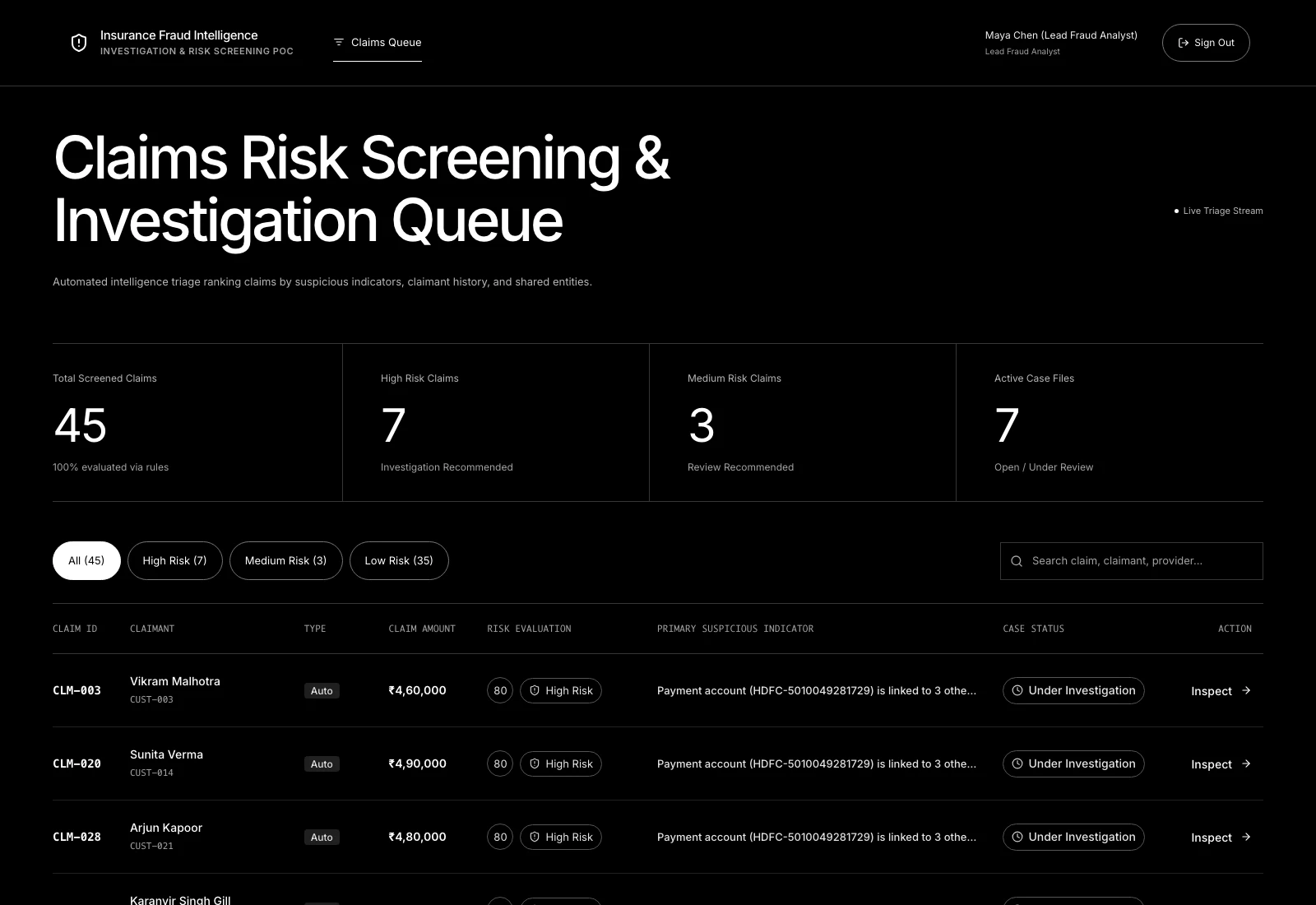
1. Analyst Authentication & One-Click Demo Access
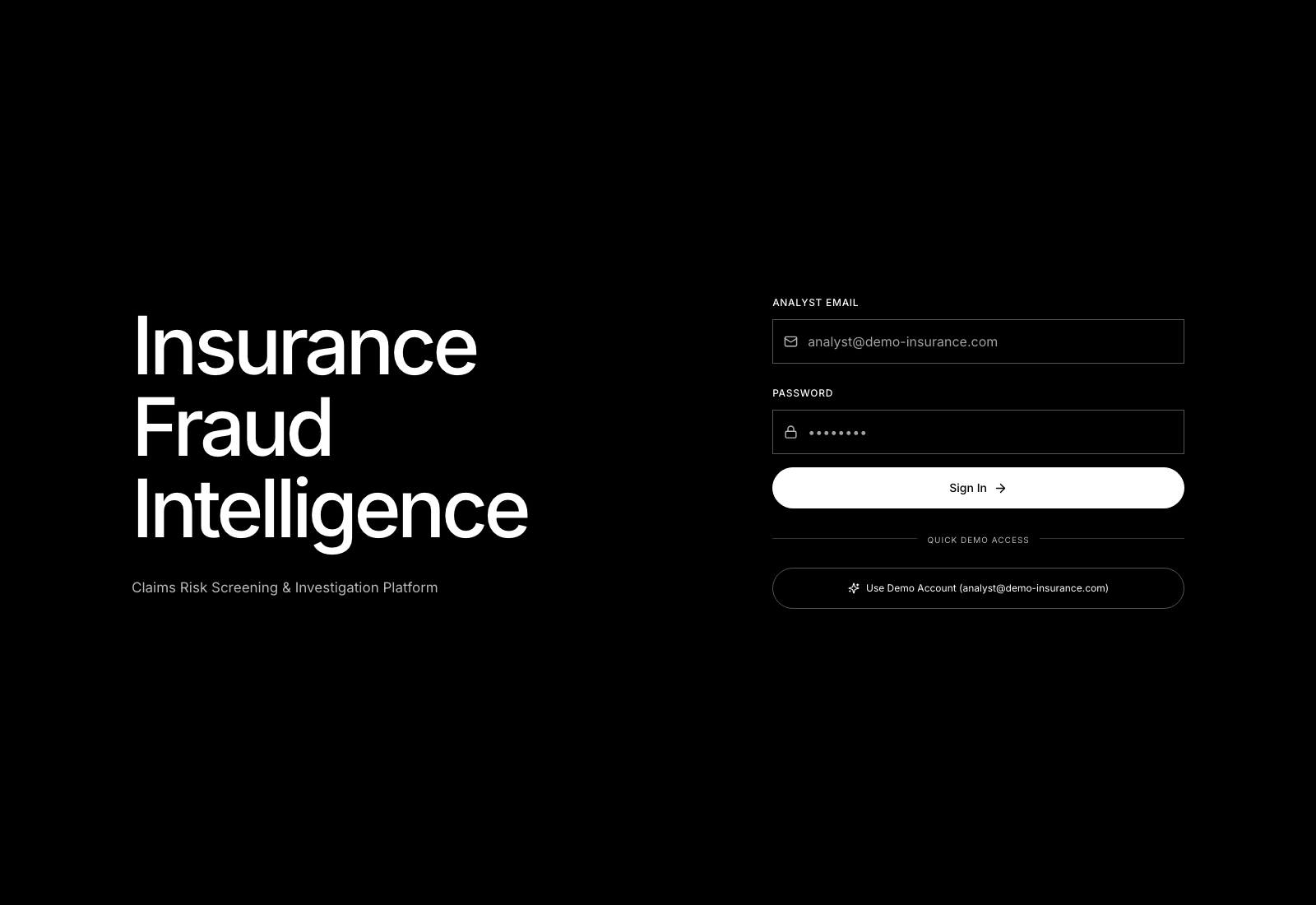
2. Claims Risk Screening & Triage Queue Dashboard
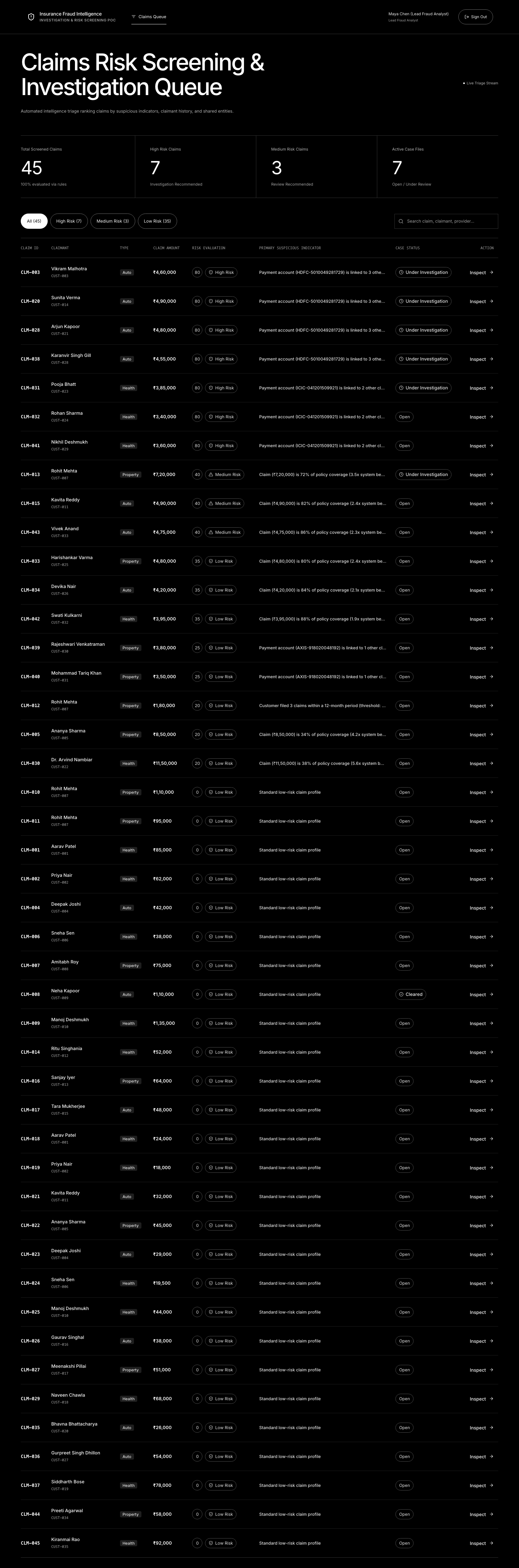
3. Claim Intelligence, Explainability & Case File
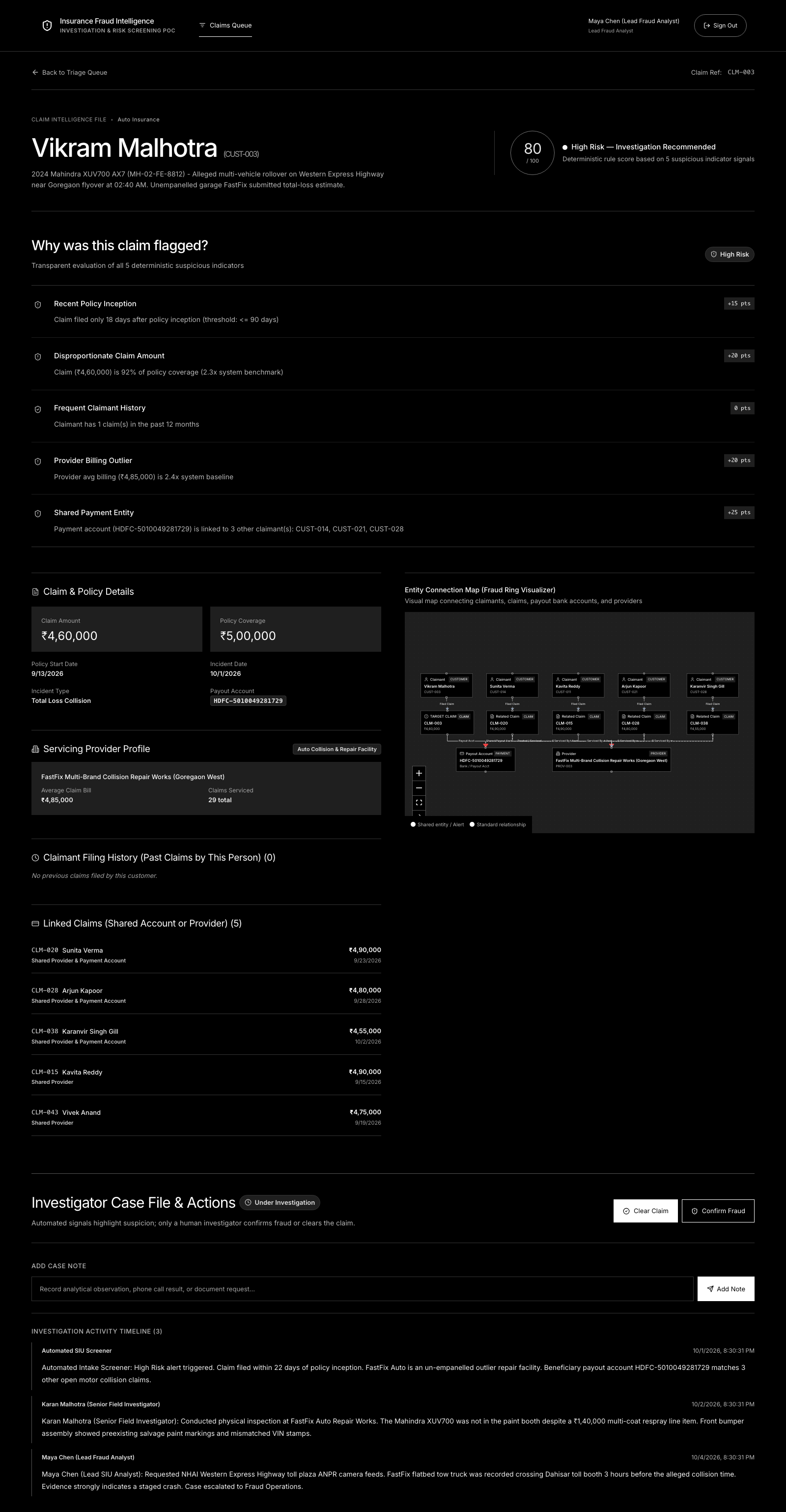
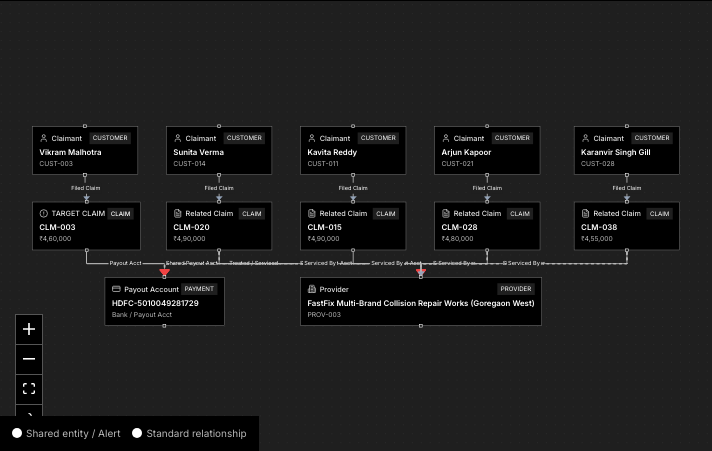
4. Multi-Entity Relationship Graph (Fraud Ring Visualizer)
1. Executive Summary & Core Concept
The Problem: Claim-by-Claim Screening
Traditional fraud screening evaluates claims in isolation. An adjuster examines a claim based solely on the documents submitted for that single incident. If a claim appears reasonable on paper (for example, a ₹4,80,000 auto collision with an itemized repair invoice), isolated screening rules approve it.
However, coordinated fraud patterns are difficult to detect when claims look plausible on their own:
- Different individuals file separate claims on different dates.
- Payouts route into the same collection accounts.
- Repairs or treatments are certified through the same outlier facilities.
- Policies are purchased shortly before staged incidents occur.
The Proposed 4-Step Approach
┌────────────┐     ┌──────────────┐     ┌─────────────┐     ┌───────────────┐
│ 1. DETECT  │ ──> │ 2. PRIORITIZE│ ──> │ 3. EXPLAIN  │ ──> │ 4. INVESTIGATE│
└────────────┘     └──────────────┘     └─────────────┘     └───────────────┘
  Suspicious          Composite           Point-by-point      Interactive
  claim & entity      risk score          transparent         graph, notes,
  signals             (0-100)             breakdown           & determination
- DETECT: Find suspicious signals in claims, history, provider behavior, and payment relationships.
- PRIORITIZE: Combine signals into a simple risk score so investigators know what to inspect first.
- EXPLAIN: Show the exact reasons and point contributions behind every score.
- INVESTIGATE: Show related entities and let the investigator review evidence and record a determination.
Human-in-the-Loop Governance
The software does not automatically deny or approve claims or accuse individuals of fraud. Automated scoring serves prioritization and evidence synthesis; only a human investigator records findings and determinations (Under Investigation, Clear Claim, Confirm Fraud). Downstream legal and payment decisions remain with the insurer.
2. Tech Stack & Selection Rationale
| Layer | Technology | Rationale |
|---|---|---|
| Frontend Framework | React 18 + Vite | Fast development server, rapid bundle builds, and standard component-driven UI. |
| Styling | Tailwind CSS | Clean design system, responsive layouts across desktop and mobile, with zero runtime CSS overhead. |
| Routing | React Router v6 | Client-side routing with protected routes and clean URL states (/claims/:claimId). |
| Graph Visualization | React Flow (@xyflow/react) + Dagre | Interactive canvas with automatic hierarchical layout for multi-entity relationship discovery. |
| Icons & UI | Lucide React | Consistent enterprise iconography. |
| API Client | Axios | Configured with withCredentials: true for HTTP-only cookie session management across domains. |
| Backend Runtime | Node.js + Express 4 | Lightweight, modular REST API structure with dedicated route controllers. |
| Database | MongoDB Atlas + Mongoose | Flexible document store with dedicated database user scoped exclusively to insurance-fraud-poc. |
| Authentication | JWT via HTTP-Only Cookies | Session security with bcrypt password hashing, sameSite: "none" (HTTPS production), and httpOnly: true. |
| E2E Testing | Playwright | Browser automation suite orchestrating both backend and frontend workflows. |
3. Engineering Decisions & Architecture
-
Explainable Rules vs. Black-Box Machine Learning:
- In insurance operations, opaque ML score outputs cannot easily be audited or explained during a disputed claim.
- Built a deterministic 5-signal scoring engine with itemized weights and natural-language evidence strings. Every score is fully transparent and auditable.
- With sufficient labeled data and governance, this same workflow could later incorporate machine learning and anomaly detection.
-
False Positive Protection on Legitimate High-Value Claims:
- Naive systems flag any large claim as suspicious, creating friction for honest customers experiencing genuine catastrophic losses.
- Evaluates coverage ratio and provider baselines together rather than relying on absolute dollar amount alone. For example, claim
CLM-030(Dr. Arvind Nambiar) involves a ₹11,50,000 emergency bypass surgery on a long-standing 5.7-year policy at an accredited hospital, correctly receiving a Low Risk (20 pts) score.
-
Multi-Entity Relationship Mapping:
- Avoids the operational overhead of a separate graph database for this POC by querying indexed payment account and provider references in MongoDB, passing nodes and edges to
@xyflow/reactand@dagrejs/dagrefor client-side hierarchical rendering.
- Avoids the operational overhead of a separate graph database for this POC by querying indexed payment account and provider references in MongoDB, passing nodes and edges to
-
Dedicated Database Isolation:
- Connects to MongoDB Atlas using credentials scoped exclusively to
insurance-fraud-pocwithreadWriteaccess, preventing any interaction with other databases on the cluster.
- Connects to MongoDB Atlas using credentials scoped exclusively to
-
Persistent Investigation Audit Trail:
- Case decisions, timeline notes, author attribution, and outcome rationales persist directly to MongoDB via
PATCH /api/investigations/:claimId.
- Case decisions, timeline notes, author attribution, and outcome rationales persist directly to MongoDB via
4. Deterministic Risk Engine & Scoring Model
The risk engine evaluates 5 deterministic signals totaling a maximum of 100 points:
| Signal ID | Indicator Name | Weight | Trigger Condition |
|---|---|---|---|
recent_policy | Recent Policy Inception | +15 pts | Claim incident occurs $\le 90$ days after policy purchase date. |
high_claim_amount | Disproportionate Claim Amount | +20 pts | Claim amount $\ge 70%$ of policy coverage OR $\ge 2.2\times$ system-wide provider baseline. |
repeated_claims | Frequent Claimant History | +20 pts | Customer filed $\ge 3$ claims within the previous 12 months. |
provider_anomaly | Provider Billing Outlier | +20 pts | Servicing facility average claim exceeds $1.5\times$ system-wide provider baseline. |
shared_entity | Shared Payment Entity | +25 pts | Payout bank account is linked to $\ge 2$ distinct claimants. |
System Baseline: The system-wide synthetic provider baseline used by this POC is approximately ₹2,04,100.
Risk Tiers
- High Risk ($\ge 70$ pts): Investigation Recommended. Straight-through processing halted; flagged for investigator review.
- Medium Risk ($40 - 69$ pts): Review Recommended. Flagged for senior desk adjuster evaluation.
- Low Risk ($< 40$ pts): Standard Processing. Eligible for standard operational workflows.
5. Seeded Dataset & Key Scenarios
The database is pre-seeded with 45 claims and 10 providers across auto, health, and property lines:
- Coordinated Auto Collision Cluster (High Risk — Score: 80):
- Claims
CLM-003,CLM-020,CLM-028, andCLM-038share the same synthetic bank payout account (HDFC-5010049281729) and all route to outlier repair workshop FastFix Multi-Brand Collision Repair Works (billing 2.4x baseline). - Each claim was filed within 20–45 days of policy purchase, requesting 80%–92% of coverage limits.
- Claims
- Coordinated Soft-Tissue Inpatient Cluster (High Risk — Score: 80):
- Claims
CLM-031,CLM-032, andCLM-041share accountICIC-041201509921and bill inpatient packages at Sunrise Wellness & Spine Rehabilitation Centre (an outpatient facility with zero licensed overnight beds).
- Claims
- Serial Claimant Velocity (Medium Risk — Score: 40):
- Claim
CLM-013(Rohit Mehta): 4th property claim filed within 12 months on policyPOL-PROP-HOME-30419(+20 frequent claimant, +20 disproportionate claim amount).
- Claim
- Suspicious Relationship Indicators (Low Risk Baseline — Score: 25):
- Claims
CLM-039andCLM-040share a contractor payout account (AXIS-918020048192). Because no other compounding fraud signals are present, each scores 25 (Low Risk). The shared account is flagged as a relationship indicator without prematurely triggering a high-risk alert.
- Claims
- Legitimate High-Value Controls (Low Risk — Score: 20):
CLM-030(Dr. Arvind Nambiar): ₹11,50,000 emergency CABG heart surgery on a 5.7-year policy at accredited Metro General Hospital. Only disproportionate amount triggers (+20); remains Low Risk.CLM-005(Ananya Sharma): ₹8,50,000 structural fire on a 3.5-year policy with verified municipal fire brigade report.
- Clean Baseline Claims (Low Risk — Score: 0):
- 33 routine genuine claims (stone-chip windshield replacements, cataract procedures, dengue recovery stays, minor pipe repairs).
6. The 7 REST APIs
Authentication Endpoints
POST /api/auth/login: Authenticates analyst credentials (analyst@demo-insurance.com/demo123), issues HTTP-only JWT cookie (token).POST /api/auth/logout: Clears the JWT cookie and terminates the session.GET /api/auth/me: Validates session cookie and returns current analyst profile.
Intelligence & Investigation Endpoints
GET /api/dashboard: Computes risk scores across all claims, aggregates KPI metrics (totalClaims,highRisk,mediumRisk,lowRisk,openInvestigations), and returns the prioritized queue.GET /api/claims/:claimId: Returns complete dossier for a claim: risk breakdown, policy snapshot, servicing provider statistics, customer claim history, linked claims, and investigation records.GET /api/claims/:claimId/relationships: Generates nodes and edges for the React Flow visualizer, mapping claimants, claims, providers, and payout accounts.PATCH /api/investigations/:claimId: Updates case status (under_investigation,cleared,confirmed_fraud), appends timestamped investigator notes, and records outcome rationales.
7. Application Walkthrough
1. Login Page (/login)
- Dedicated analyst sign-in with a one-click "Use Demo Analyst Account" button for immediate evaluation.
2. Claims Risk Screening & Triage Queue (/)
- Summary KPI cards: Total Screened Claims (45), High Risk (7), Medium Risk (3), Active Case Files.
- Filter tabs: All (45), High Risk (7), Medium Risk (3), Low Risk (35).
- Search filter matching claim IDs, claimant names, providers, and accounts.
- Clean table displaying Claim ID, Claimant, Policy Type, Amount, Risk Evaluation (score + badge), Primary Suspicious Indicator, Case Status, and Action.
3. Claim Intelligence & Investigation Case File (/claims/:claimId)
- Score Wheel & Badge: Color-graded risk indicator.
- Explainability Card: Itemized view of all 5 deterministic signals with points and evidence.
- Servicing Provider Profile: Provider classification, claim volume, and average bill compared to baseline.
- Claimant Filing History: Previous claims filed by the same policyholder within the past 12 months.
- Linked Claims: Claims connected via shared bank accounts or providers.
- Entity Connection Map: Interactive React Flow graph with animated alert edges connecting shared entities.
- Investigator Case File: Status controls (Start Investigation, Clear Claim, Confirm Fraud), case note input, and persistent chronological activity timeline.
8. Setup & Testing
Running Locally
# 1. Install root dependencies
npm install

# 2. Start frontend (:5173) and backend (:3001) concurrently
npm run dev
Seeding Demo Data
# Reset MongoDB database to default 45 claims and 10 providers
npm run seed
Running Automated Playwright E2E Tests
# Run the 6-spec test suite:
npx playwright test --reporter=list

# Run tests with visible browser window:
npx playwright test --headed
Test Suite Performance: All 6 end-to-end tests pass in ~6.8 seconds, verifying authentication, triage filtering, signal explainability, graph rendering, case note database persistence, and false-positive controls against the running application.
A problem worth exploring.
A company-requested proof of concept for investigating relationships between claims, providers and payment accounts.
Inside the build.
- 01
A deterministic rules-based score prioritizes investigation; it is not ML inference.
- 02
React Flow relationship views help explore connected entities.
- 03
Investigation notes and decisions persist in MongoDB. All demo data is synthetic.